 This is the period of the long rains in Tanzania, although you wouldn’t know it living in Dar es Salaam. Certainly, there has been the occasional rainstorm, but nothing voluminous enough to warrant the name. Inland perhaps it’s another story, as safari traffic typically slows to a halt in the national parks and game reserves. In fact, many camps and lodges are closed in April and May, leaving tourists and expatriate residents with the impression that the dirt roads are all impassable and the wild animals impossible to see. For birders, though, the rainy season is a glorious time in the savannah as many bird species develop their breeding plumage and seem to call all day. With the famous northern national parks beckoning green and empty, then, I decided to spend half of my weeklong vacation revisiting the celebrated Tarangire National Park, and the other half discovering the little-visited Amani Nature Reserve in the Eastern Usambara Mountains. In both places, the birding would prove significantly more impressive than the weather.
 Tarangire is a long ways from Dar by tarmac road, which snakes up along the Western Umbasaras practically to the border with Kenya before looping back around to the southwest. Making a brief stop in Arusha, my colleague Cyrille and I spent twelve straight hours in the car, trading driving responsibilities in strictly managed two-hour intervals. It was brutal, but it would have been worse in my car, which doesn’t have air conditioning and rides a bit rougher. Despite the fatigue, our spirits soared as we headed from Arusha out into the open spaces of the Rift Valley. Passing languid goat herders from Maasai villages along the road, we raced to the park entrance before the gate closed at sunset. Tarangire Safaari Lodge had offered us a nice discount on one of their classic ensuite tents on the bluff overlooking the river, and we were hoping to start off our vacation by knocking back a few sundowners before dinner. Settling down on the terrace with a gin and tonic, I took in the beautiful scene spread out before us in the dying light: a family of elephants crossed the river, which was full from bank to bank, and marched slowly past the verdant baobab trees.
 I awoke at dawn to a growing chorus of birdsong and lay in my bed peacefully, content to let the day slowly permeate through the windows and door to our tent. Within a few minutes, though I was stirred by an unfamiliar call, and thinking it could be a Rosy-Patched Bush-Shrike (I'm obsessed with bush-shrikes, none of which I've seen), I was dressed and out of the tent with my gear within seconds. Birding on foot along the bluff over the next few days would prove to be remarkably productive, as I cleaned up on some acacia forest species that I had missed on my previous trip to northern Tanzania, including Eastern Violet-Backed Sunbird, African Orange-Bellied Parrot, and Grey Woodpecker. More impressively, the bluff would yield some excellent views of perched and soaring raptors, including Martial Eagle, Brown Snake-Eagle, and Bateleur. For a few hours, then, I walked slowly back and forth in front of the empty tents, following up on different calls and coming quite close to a variety of fine birds for photographs, such as Red-and-Yellow Barbet, Nubian Woodpecker, and Ashy and Superb Starlings.
 After a late breakfast, Cyrille and I decided it was finally time for a game drive, and we set off to along the Tarangire River, sticking to the northern side as the high water had overwhelmed the bridge. The story you’ll hear about going on safari in the rainy season is that the parks are more beautiful but the game is dispersed throughout the high grass, but that morning we must have encountered over a hundred elephants, dozens of giraffe, and a variety of antelope species. Unfortunately, we were also bombarded by tetse flies, which seemed to swarm through the windows of the car anytime we stopped to watch an animal or bird. These tough and nasty flies are famous for transmitting sleeping sickness with their painful bites; while the disease is very rare in this part of East Africa, we soon had multiple bites on our exposed ankles and arms. In defense, we rolled up the windows and turned on the air conditioning, which was an unpleasant but unavoidable strategy. As the bites on my ankles, arms, and face began to swell up uncomfortably over the next few days, I realized why this part of the country is still pristine in many parts and generally uninhabited: despite its beauty and fertile plains, insects and disease will quickly ravage humans and their relatively fragile livestock.
 Before turning back to the lodge for lunch, I had spotted a number of new bird species, including Bare-Faced Go-Away-Bird, Brown-Crowned Tchagra, and Cardinal Quelea. It was Cyrille, though, who pointed out my first male Eastern Paradise-Whydah in breeding plumage, which must be one of the most delightful avian sights in East Africa. In the parking lot of the lodge, which is set amidst mature acacia woodland, I noticed an African Scops-Owl roosting on a branch snugly against a tree. At about 17 cm, this diminutive owl is widespread and common, but strictly nocturnal and tricky to notice during the daytime. The owl seemed too tired to be bothered by the sounds of my camera, but at one point it objected to my presence by drawing up tall and thin on its perch and raising its ear tufts slightly. Over lunch we noticed another tiny owl, this time the diurnal Pearl-Spotted Owlet, being mobbed by a variety of small birds as it hunted for insects and small lizards around the patio. Our luck with owls would continue that evening as we came across a pair of massive Verreaux’s Eagle-Owls at sunset.
 Our most significant wildlife observation also came on that game drive, as we wound our through the tall grass along one of the many river circuits near the lodge. We stopped short in front of a Serval Cat that was ambling towards us on the track. Totally unfazed by the car, it sat on its haunches for a minute and stared around with heavy-lidded eyes, probably having just arisen from sleep. Passing right along the car, it then entered the tall grass where it stalks birds and rodents its on long legs. “No one ever photographs a Serval,” people keep telling me, but it’s the same cat that my friend Mark saw at the Momela Lakes in Arusha National Park in December, so it can’t be that rare to see. As this was the only cat we encountered during our four days in the park, having missed the lion, cheetah, and leopard, it ultimately helped to hear how lucky we were to find it. In fact, only one other group of tourists saw any cats that week, noting a female lion and her cub near Sopa Lodge, which was considerably deeper in the park than we would explore.
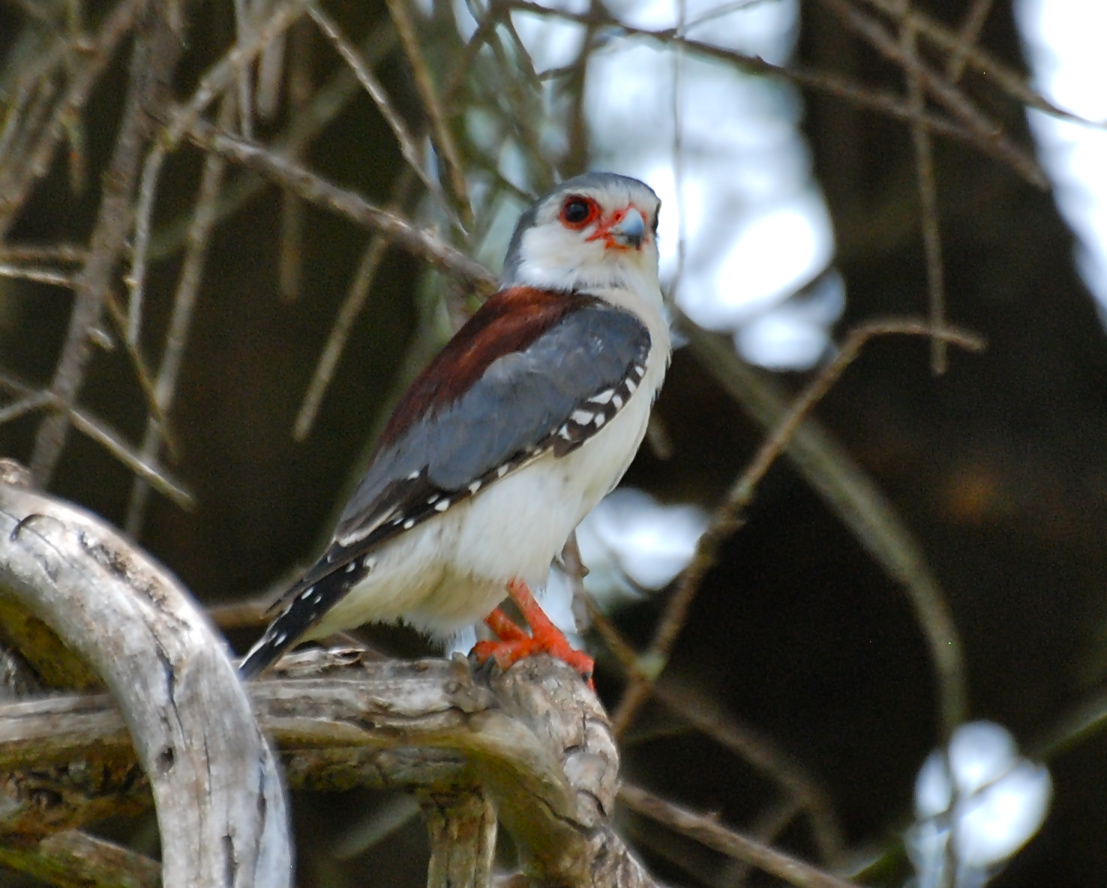 On the second day, we had originally planned to drive to the large swamp system in the remote southern section of the park, but with the rivers swollen with the rain in the hills, and with a shaky car battery, we decided to stay closer to the lodge. Our morning game drive took us past a juvenile Martial Eagle, which I confidently identified this time instead of confusing it with the African Crowned Eagle like I did at Sadaani National Park in February (it’s critical not to be distracted by the raised crest, but to focus instead on the thigh plumage and talon color). Having seen both species several times now, I also know enough to distinguish between them based on the habitat: one inhabits forest, the other savanna and more open woodland. At a small pond we also found a group of Knob-Billed Ducks, or Comb Duck as it’s known in South America, and a single Yellow-Crowned Bishop, which was another nice find by Cyrille, who’s still a fledgling birder. Throughout the grasslands, White-Winged Widowbirds and Cardinal Queleas were also in great abundance as the males established and defended their territories and chased the females wildly about.
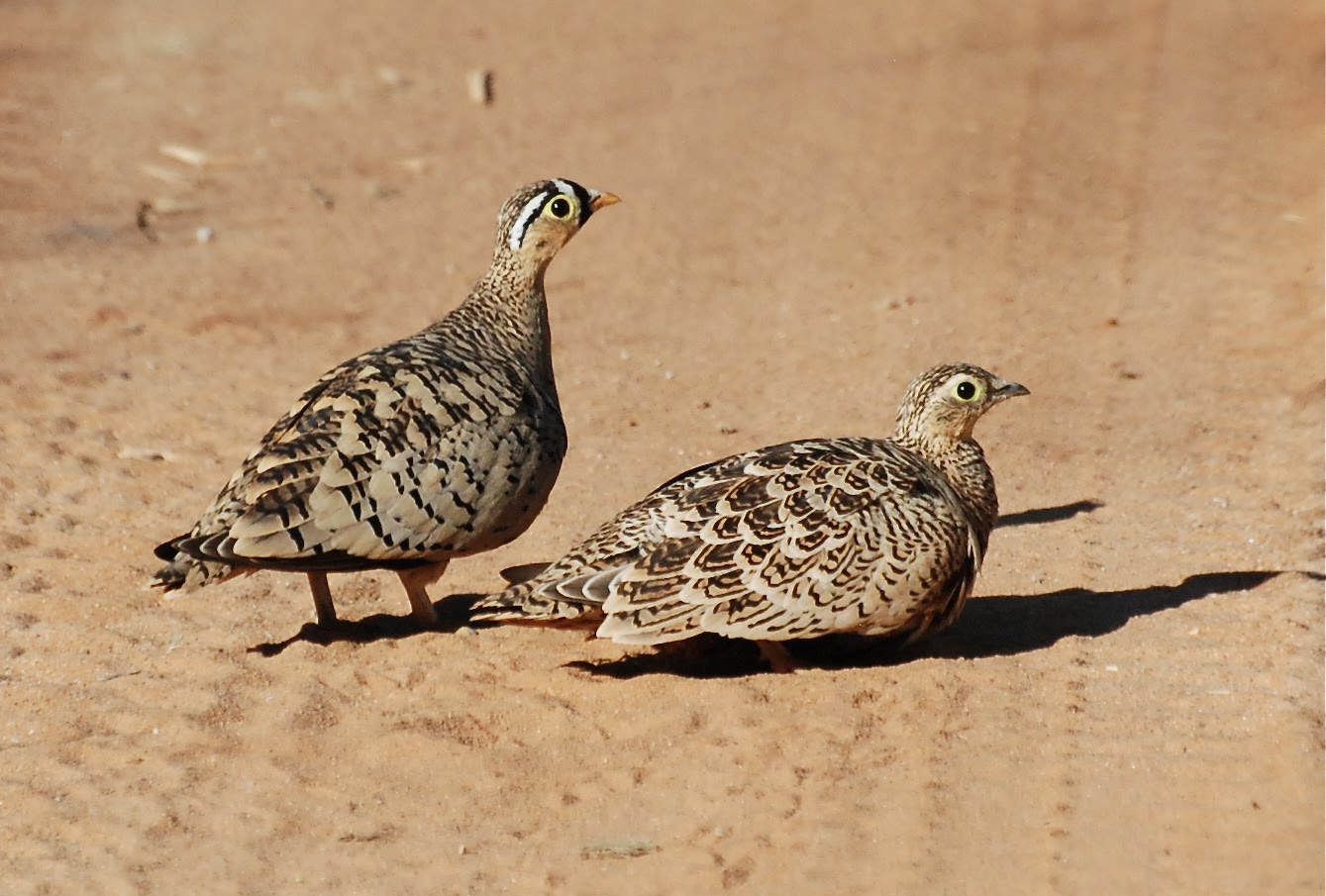
 In the evening, we drove out to the Little Serengeti area at the northern edge of the park, where the wide-open grasslands were flooded with rich yellow light. Hundreds of elephants were lumbering around, and the road was crowded with Two-Banded Coursers and a few Black-Faced Sandgrouses. We also passed a group of Rufous-Tailed Weavers that were foraging alongside of Red-Billed Buffalo-Weavers. The former is one of the Serengeti-Mara endemic bird species and has been placed in its own genus despite its association with the buffalo-weavers. As the light faded we headed back to the lodge, having searched half-heartedly along the river again for a leopard. We would leave for the Eastern Usambaras the following morning, which would turn out to be a much greater endeavor than we had planned.
Notable birds seen: Hamerkop, Marabou Stork, White Stork, Yellow-Billed Stork, White-Faced Whistling-Duck, Knob-Billed Duck, African White-Backed Vulture, Black-Shouldered Kite, African Fish Eagle, Tawny Eagle, Martial Eagle, Bateleur, Brown Snake-Eagle, Crested Francolin, Helmeted Guineafowl, Red-Necked Francolin, Yellow-Necked Francolin, Common Button-Quail, Black-Faced Sandgrouse, Spotted Thickknee, Two-Banded Courser, White-Bellied Bustard, Yellow-Collared Lovebird, African Orange-Bellied Parrot, Bare-Faced Go-Away-Bird, White-Bellied Go-Away-Bird, Red-Chested Cuckoo, Verreaux’s Eagle-Owl, Pearl-Spotted Owlet, African Scops-Owl, Woodland Kingfisher, Gray-Headed Kingfisher, Pied Kingfisher, African Pygmy Kingfisher, Little Bee-Eater, European Bee-Eater, Lilac-Breasted Roller, European Roller, African Hoopoe, Red-Billed Hornbill, Von der Decken’s Hornbill, Red-and-Yellow Barbet, Nubian Woodpecker, Bearded Woodpecker, Grey Woodpecker, White-Browed Scrub-Robin, Spotted Morning-Thrush, Grey-Backed Camaroptera, Yellow-Breasted Apalis, African Paradise-Flycatcher, Northern Pied Babbler, Beautiful Sunbird, Scarlet-Chested Sunbird, Eastern Violet-Backed Sunbird, Magpie Shrike, Brown-Crowned Tchagra, Red-Winged Starling, Ashy Starling, Swahili Sparrow, Red-Cheeked Cordon-Bleu, Cardinal Quelea, White-Winged Widowbird, Eastern Paradise-Whydah, Pin-Tailed Whydah, Yellow-Crowned Bishop.
