Showing posts with label birding in Florida. Show all posts

Wednesday, November 13, 2013

My Upcoming Birding Events this Winter!

This year is the last year that our daughter Phoebe will be living full-time in the home nest. She'll be off to college somewhere fabulous in the fall and I was motivated to try my best to stay home more often this year to hang around with The Pheebster. I probably should have asked HER about this, since she's leading the never-stop life of a high-school senior and is rarely at home. Nevertheless, I turned down a number of opportunities to travel and a handful of speaking gigs at festivals.

But I'm STILL hitting the road quite a bit and here are some of the upcoming what's, when's, and where's, through January 2014.
There won't be any Philly vireos present when I'm in Philly speaking to the DVOC.
DVOC Annual Banquet • Philadephia, PA • November 21, 2013
I'm the annual banquet speaker for the Delaware Valley Ornithological Club (DVOC) on Thursday, November 21. This venerable Philadelphia-area bird club traces its origins back to the 1880s. Its list of previous annual banquet speakers reads like a who's who of American birding. It's an honor to give a presentation to this group. I'm giving the "Perils and Pitfalls of Birding" talk, so I hope I can get a chuckle or two from the crowd. Registration details are here.

Giant flocks of sandhill cranes will be filling the skies at Wings Over Willcox.
Wings over Willcox • Willcox, Arizona • January 15–19, 2014
I think I know why the acronym of this event is WOW. It's probably the thousands of sandhill cranes that winter in this region, plus all the waterfowl. Or maybe because, despite being held in mid-winter, Wings Over Willcox always has a bird list of about 140 species. I'm giving a talk and attending a wine dinner and I'm looking forward to helping out on a few field trips. Get WOW info here.

Limpkins are fairly easy to see at Viera Wetlands during the Space Coast Birding Festival.
Space Coast Birding and Wildlife Festival • Titusville, Florida • January 22–27, 2014
This down-home event along Florida's central Atlantic coast seems to grow larger every year in terms of programming offered, field trips, and number of attendees. It's become one of the must-do birding festivals because the birding is great, the vendor hall is filled to bursting, there's great seafood to be eaten, and let's face it, Florida is a fine place to be in late January if you live anywhere on the planet that still has winter. I'm not speaking at this year's event, but I'll be there manning the Bird Watcher's Digest booth and I'm a co-leader on a couple of field trips. If you've never been, perhaps this is your year: http://www.spacecoastbirdingandwildlifefestival.org/


Ibi in the sunset at Merritt Island NWR.

That's it people. I'll see you out there with the birds!


Thursday, January 31, 2013

A Rarely Seen Field Mark

A drake ring-necked duck.

Many birders have asked themselves, when afield and bird watching, why certain birds are named for virtually indiscernible field marks. The red-bellied woodpecker may (or may not) have a wash of pale red upon its belly, but that belly is nearly always pressed up against a tree trunk, rendering the field mark useless.

Raise you hand if you've seen the orange crown on an orange-crowned warbler!

Try telling short-billed and long-billed dowitchers apart using only your binoculars. It's tough, man!

These field marks are reminders to us that many of our native birds were named during the shotgun era of ornithology when men (yes it was mostly men) took to nature with gun and gamebag and shot any bird they saw—especially ones that were unfamiliar to them. These unknown birds were examined in the hand and sometimes given names that seemed perfectly useful to an gun-toting ornithologist who was nearly always going be looking at bird corpses up close rather than living, flying birds at a distance.

Roger Tory Peterson helped the ornithologists and bird enthusiasts of the day put down the shotgun and pick up the binoculars when he introduced his Field Guide to Birds in 1934. In this guide, RTP provided a system of bird identification based upon field marks that could be seen from a distance. No need to shoot every bird to know what it is, or rather, used to be.

The ring-necked duck is a perfect example of this shotgun nomenclature. It's a rare thing to see the ring on a drake ring-necked duck in the field. If Peterson or some other bino-toting bird guy (or gal) had been the first to discover this species it might have more properly been named ring-billed duck for the apparent rings of black, white, and gray on its bill.

Drake ring-necked duck, showing the ring of rusty-brown at the base of the neck.
On a recent trip to the Space Coast Birding and Wildlife Festival in Florida I happened upon a cooperative drake ring-necked duck at Viera Wetlands. I must confess that it wasn't until I was looking at my images, back home in icy Ohio that I noticed that I had caught several shots that showed the ring on the neck of this species.


Pretty neat stuff! And no birds were killed in the process! Well, I did eat chicken for dinner that night, but that's a story for another time.

Tuesday, January 22, 2013

Space Coasting

Limpkin at Viera Wetlands near Cocoa, FL.
I feel only a little bit guilty for escaping the single-digit temperatures of southeastern Ohio this week for the relatively balmy temps along Florida's east coast. It's time once again for the annual Space Coast Birding & Nature Festival in Titusville, FL. This is one of the top events in the annual calendar of birding festivals. Its location is ideal for birding with great habitat and dynamic—even endangered—bird species nearby. Its timing in late January often coincides with the first days of winter despair for those of us who live in the rusty snow belt of the upper Midwest. And the folks who run the fest are just really nice and accommodating. Bird Watcher's Digest has been a sponsor of this birding festival since its inception.

Ruddy turnstone in winter plumage.
Oh, the reason it's called the Space Coast Birding & Nature Festival is because NASA's Cape Canaveral launch facility is located nearby. All those Apollo missions and Space Shuttle launches started from right here.

Florida scrub-jay.
 Two of my favorite birding locations during the festival are Viera Wetlands and Merritt Island National Wildlife Refuge. Both locations are a short drive from the community college auditorium and campus where the festival has its base. And both places offer amazing opportunities for birding, bird photography, and for appreciating the incredible natural diversity of this part of The Sunshine State. Brevard County certainly has its heavily developed areas but it also has a significant amount of protected natural habitat—and wherever this habitat occurs, it's as birdy as heck.


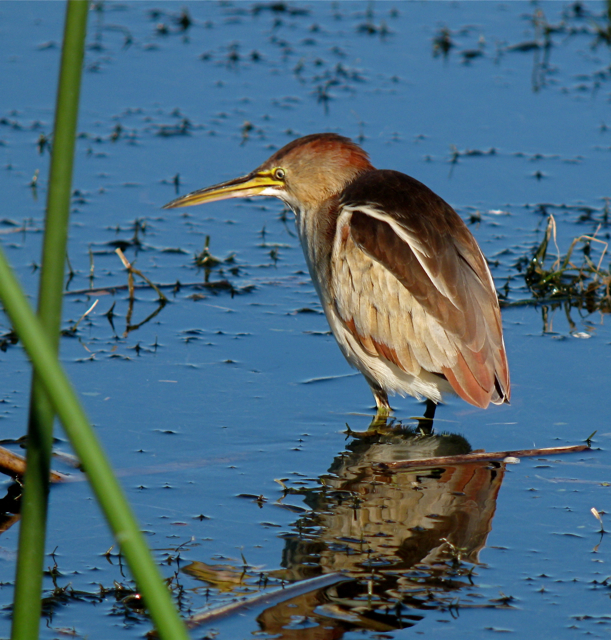
Least bittern photographed at Viera Wetlands.

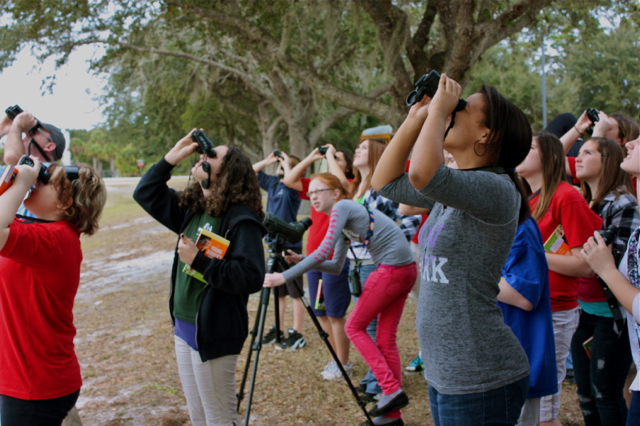
 The last time I made the scene at Space Coast, I was accompanied by daughter Phoebe (then in 8th grade) and we spent several days visiting schools to take classrooms of her fellow 8th graders out birding. This was super fun!

 Phoebe also helped me at the book signings for The Young Birder's Guide to Birds of Eastern North America which she and her classmates at Salem Liberty Elementary helped me conceptualize and write. That's my friend and editor Lisa White from Houghton Mifflin Harcourt in the photo above. She was probably coaching me on how to spell my name properly during the book signing... B-I-L-L...

 On two separate afternoons, Phoebe and I escaped to the beach at Canaveral National Seashore. She was longing to see the ocean. It was cold, but we still took off our shoes and socks and rolled up our pants legs and raced into the surf.


Phoebe and me on the beach.


In fact I think it's safe to see that seeing that Phoebe on the beach just as happy and free as she could be was my favorite bird sighting of the entire week!

Do yourself a favor and visit The Space Coast Birding & Nature Festival's website and then make plans for your own late-January escape to Florida's Atlantic coast.

Thursday, November 3, 2011

Roadside Attractions

In January 2010 I took daughter Phoebe to Florida for The Space Coast Birding & Wildlife Festival. We did a number of speaking gigs at the festival and at local schools. It was really cool to see Phoebe interacting with kids her age from the Florida schools, showing them, without a doubt, that birding is not just for nerds.

It was a highlight of my years as a Dad to be able to show Phoebe her life alligator, armadillo, manatee, bobcat, and a score of birds, including the endangered Florida scrub-jay. But there was one Florida lifer that eluded us: the giant roadside attraction.

On Sunday, when the festival was over, we headed for the Orlando airport by a roundabout way. A giant alligator at a roadside attraction provided a perfect memento for Phoebe. We stopped, she got out, and we took a few photos with this big-as-a-tractor-trailer gator.

I love this image because it shows my little girl, who is no longer a little girl, in full "hurry up and take the photo, Daddy!" posture. What a gator! What a trip! And what a girl! We really need to do another daddy-daughter trip before fledges into the wide world on her own two wings.

Friday, September 30, 2011

Angry Birds

The new Nature's Classroom facility at St. Marks National Wildlife Refuge.

I was down in the Florida panhandle a while ago, helping to open a wonderful new building at St. Marks National Wildlife Refuge called "Nature's Classroom." This facility will serve as a resource for area residents, teachers, students, birders, photographers, and nature enthusiasts, giving them a place to meet, learn, explore, and a base from which to enjoy St. Marks NWR.

Some of the team responsible for the new Nature's Classroom building at the ribbon-cutting.

While there I gave three talks and lead a couple of bird walks, one of which was on the Plum Orchard Trail behind Nature's Classroom. We had 30 or so folks along, including some keen young bird watchers, and the birding was fairly good, considering it was a hot, muggy afternoon. We had lots of red-eyed vireos, eastern kingbirds, a green heron, immature white ibis, little blue heron, tricolored heron, pine warbler, four woodpecker species, and a noisy flock of brown-headed nuthatches. But the most interesting sighting happened right at the end of the walk on the sandy pool of water behind Nature's Classroom.

As we returned on the loop trail, one of our group spotted two shorebirds out on the pool. We initially thought they were spotted sandpipers because there were lots of spotties around and because they were teetering their tails the way that spotted sandpiper often do. But as they came out of the vegetation and walked closer it was clear that they were the larger solitary sandpiper. And they were really behaving weirdly: running around excitedly, bobbing almost constantly, looking into the grass.

Solitary sandpipers doing their best Angry Birds impression.

That was when the object of their attention slithered into view: a banded water snake came gliding toward the birds. The birds seemed to be conflicted about this: should they run or should they fight? As soon as the snake would head away from them, the solitaries would chase it. If the snake came toward them, they scampered away. Certainly the snake was too large for them to kill and eat, and I'm not sure that the snake could have subdued the sandpipers, so they were left to perform pantomime parries and thrusts with no actual attacks.

The whole scene lasted just a few minutes, but it was interesting to watch. I guessed that these birds might have been youngsters migrating south with the fall, and this might have been their first snake encounter.

Solitaries and the water snake.

This was my first trip to St. Marks—one of our oldest national wildlife refuges. What a fantastic place it is! I'm certain I'll be back again for another visit.

Sunday, September 25, 2011

St. Marks Morning

It's been a wild few weeks here at Bill of the Birds international corporate headquarters. Apologies for the mostly unavoidable dead air here on the blog. So, as an attempt at making this up to my patient readers, here's a much-needed Moment of Bliss for you and me.

The image above was taken yesterday morning along the road to the St. Marks lighthouse. The air was cool and humid, with that whiff of brackish marsh. Birds dotted the sky as though the heavens spilled its pepper mill and I took a moment to feel my feet on the ground, to fill my lungs with sweet morning air, to count the glory rays striking skyward from the rising sun. It was so peaceful. Life at that moment, well, it was very good.

Then my camera battery ran out.

More soon.