Showing posts with label birding with kids. Show all posts

Tuesday, January 22, 2013

Space Coasting

Limpkin at Viera Wetlands near Cocoa, FL.
I feel only a little bit guilty for escaping the single-digit temperatures of southeastern Ohio this week for the relatively balmy temps along Florida's east coast. It's time once again for the annual Space Coast Birding & Nature Festival in Titusville, FL. This is one of the top events in the annual calendar of birding festivals. Its location is ideal for birding with great habitat and dynamic—even endangered—bird species nearby. Its timing in late January often coincides with the first days of winter despair for those of us who live in the rusty snow belt of the upper Midwest. And the folks who run the fest are just really nice and accommodating. Bird Watcher's Digest has been a sponsor of this birding festival since its inception.

Ruddy turnstone in winter plumage.
Oh, the reason it's called the Space Coast Birding & Nature Festival is because NASA's Cape Canaveral launch facility is located nearby. All those Apollo missions and Space Shuttle launches started from right here.

Florida scrub-jay.
 Two of my favorite birding locations during the festival are Viera Wetlands and Merritt Island National Wildlife Refuge. Both locations are a short drive from the community college auditorium and campus where the festival has its base. And both places offer amazing opportunities for birding, bird photography, and for appreciating the incredible natural diversity of this part of The Sunshine State. Brevard County certainly has its heavily developed areas but it also has a significant amount of protected natural habitat—and wherever this habitat occurs, it's as birdy as heck.


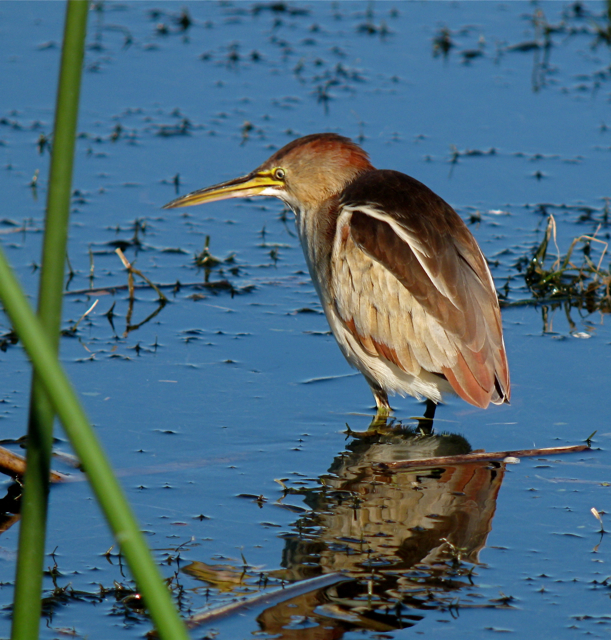
Least bittern photographed at Viera Wetlands.

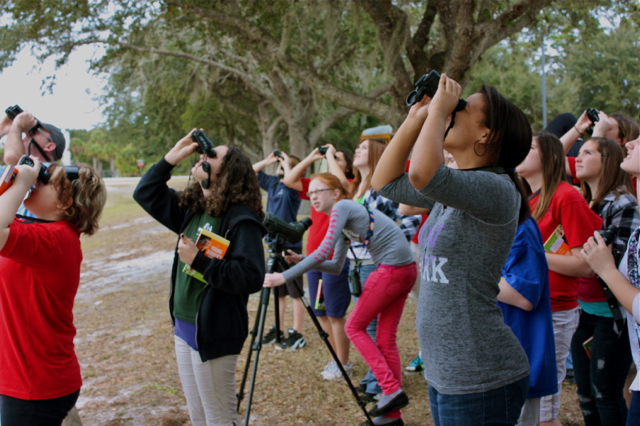
 The last time I made the scene at Space Coast, I was accompanied by daughter Phoebe (then in 8th grade) and we spent several days visiting schools to take classrooms of her fellow 8th graders out birding. This was super fun!

 Phoebe also helped me at the book signings for The Young Birder's Guide to Birds of Eastern North America which she and her classmates at Salem Liberty Elementary helped me conceptualize and write. That's my friend and editor Lisa White from Houghton Mifflin Harcourt in the photo above. She was probably coaching me on how to spell my name properly during the book signing... B-I-L-L...

 On two separate afternoons, Phoebe and I escaped to the beach at Canaveral National Seashore. She was longing to see the ocean. It was cold, but we still took off our shoes and socks and rolled up our pants legs and raced into the surf.


Phoebe and me on the beach.


In fact I think it's safe to see that seeing that Phoebe on the beach just as happy and free as she could be was my favorite bird sighting of the entire week!

Do yourself a favor and visit The Space Coast Birding & Nature Festival's website and then make plans for your own late-January escape to Florida's Atlantic coast.

Tuesday, November 27, 2012

Phoebe's Special Birding Adventure


 During our recent family sojourn in South Texas as part of the Rio Grande Valley Birding Festival, I was really happy to see daughter Phoebe (age 16) finally really get into bird watching. And because Phoebe was into it, her younger brother Liam (just turned 13) also got into it, though at a somewhat lower intensity level.

Both kids had exceptional birding moments during our six days in Texas, but it's Phoebe's experience that I'll relate here. Liam's we'll share another day.

Julie and I'd been working during the festival as guides and speakers and the kids came along where space was available. They went along on one of Julie's trips and helped me with the large group of young birders on Saturday morning. Then on Sunday we all got to be together on a Breakfast with the Birds trip to a local private ranch called Rio Costero. Al Batt was one of the other guides and he and Liam kept up a constant banter about going "squatchin'." (This means they were going hunting in the South Texas scrub for sasquatch.)

Birding a resaca at Rio Costero.

The ranch was amazing, the birding was engaging, and the breakfast was so good that we all ate too much. After taking the group bus back to Harlingen, our family hopped in the rental car and headed for South Padre Island. We'd promised the kids an afternoon at the beach—they'd never seen the Gulf of Mexico. Well, actually Phoebe had, as a three-year old, but that doesn't really count.


 Being at the beach was really fun. We frolicked in the surf despite a fairly strong undertow. We body-surfed and splashed and ran. The kids asked us to take photos of them leaping with joy.

It was hard to leave the beach, but time was winding down and there was another place, across the street from the beach access, that I wanted to visit: the boardwalk adjacent to the South Padre Island Convention Center. This boardwalk and the natural and human-enhanced habitat around it is a famous birding hotspot. In early spring the birding action is in the small trees between the start of the boardwalk and the convention center. I once did a Big Sit here during the Texas Birding Classic and it was crazy birdy. This being November, the best birding was out in the marsh through which the boardwalk winds.

 Immediately we began seeing and calling out bird after bird: northern pintail, green-winged and blue-winged teal, shovelers, Forster's and royal terns, tricolored heron, little blue heron, roseate spoonbill, American avocet, black-necked stilts. I was pleased at how many of these species Phoebe knew on her own. Liam was riffing on the birds' names—as newly minted teenaged boys are apt to do—and cracking himself up in the process.
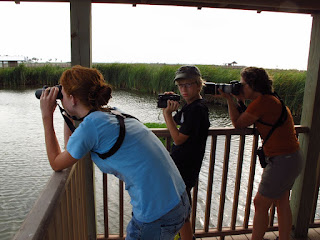
Moments before Phoebe's great bird sighting.

We ran into a small flock of familiar Ohio birders who had found an American bittern, which they were kind enough to share with us. Phoebe really like this one and we began telling her some of the natural history of the species. She even recalled seeing them before on our annual trip to North Dakota.

American bittern.
 Twenty or so minutes later, as we were turning around to head back to the car, Phoebe stopped, raised her binocs and pointed, saying "What's THAT bird? Is it another bittern? It looks smaller."
Umm. YES Phoebe, that's a least bittern!


Phoebe's least bittern!

WOW! A two-bittern day! We watched the least bittern fishing for about 40 minutes. We took photos and video. And we reached our Ohio birdpals by cellphone and returned their earlier bittern favor.

Watching the least bittern.

 I can't accurately convey how happy and proud these few moments made me. We've never pushed our kids to get into birding. Sure, we've have forced them out of bed in the wee hours regularly in their lifetimes just to bring them along with us on birding trips. And we've thrust expensive optical instruments into their tiny hands and implored them to get a good look at some fabulous bird or other. But we've never forced them to become bird watchers. Now it seems the metamorphosis is happening naturally. [Which was ALL part of our evil plan from the beginning!]

Phoebe keeping the trip bird list on our Breakfast with the Birds field trip.

Phoebe is already there. It might take Liam a bit longer. It would help if we could just get one good look at a sasquatch. Now THAT would be a lifer!


Friday, September 30, 2011

Angry Birds

The new Nature's Classroom facility at St. Marks National Wildlife Refuge.

I was down in the Florida panhandle a while ago, helping to open a wonderful new building at St. Marks National Wildlife Refuge called "Nature's Classroom." This facility will serve as a resource for area residents, teachers, students, birders, photographers, and nature enthusiasts, giving them a place to meet, learn, explore, and a base from which to enjoy St. Marks NWR.

Some of the team responsible for the new Nature's Classroom building at the ribbon-cutting.

While there I gave three talks and lead a couple of bird walks, one of which was on the Plum Orchard Trail behind Nature's Classroom. We had 30 or so folks along, including some keen young bird watchers, and the birding was fairly good, considering it was a hot, muggy afternoon. We had lots of red-eyed vireos, eastern kingbirds, a green heron, immature white ibis, little blue heron, tricolored heron, pine warbler, four woodpecker species, and a noisy flock of brown-headed nuthatches. But the most interesting sighting happened right at the end of the walk on the sandy pool of water behind Nature's Classroom.

As we returned on the loop trail, one of our group spotted two shorebirds out on the pool. We initially thought they were spotted sandpipers because there were lots of spotties around and because they were teetering their tails the way that spotted sandpiper often do. But as they came out of the vegetation and walked closer it was clear that they were the larger solitary sandpiper. And they were really behaving weirdly: running around excitedly, bobbing almost constantly, looking into the grass.

Solitary sandpipers doing their best Angry Birds impression.

That was when the object of their attention slithered into view: a banded water snake came gliding toward the birds. The birds seemed to be conflicted about this: should they run or should they fight? As soon as the snake would head away from them, the solitaries would chase it. If the snake came toward them, they scampered away. Certainly the snake was too large for them to kill and eat, and I'm not sure that the snake could have subdued the sandpipers, so they were left to perform pantomime parries and thrusts with no actual attacks.

The whole scene lasted just a few minutes, but it was interesting to watch. I guessed that these birds might have been youngsters migrating south with the fall, and this might have been their first snake encounter.

Solitaries and the water snake.

This was my first trip to St. Marks—one of our oldest national wildlife refuges. What a fantastic place it is! I'm certain I'll be back again for another visit.