Showing posts with label Western Slope. Show all posts

Sunday, June 27, 2010

Reserva Las Gralarias: June 26, 2010

A short visit to Reserva Las Gralarias was a twitch in the truest sense of the term. An active nest of the Hoary Puffleg had recently been found along one of the reserve's trails, so I simply had to stop by for my first looks at this difficult Choco endemic hummingbird, which resides in dark forested ravines and hardly ever visits feeders. Interestingly enough, this year in January the puffleg was regularly seen at one of the reserve's feeder stations that is heavily surrounded by vegetation, although I neglected to see it myself, as the twitch didn't seem as urgent as it does now that I have less than two weeks left in Ecuador.

The nest itself is cup-shaped and hanging from an exposed fern growing right along the trail. When I first arrived on site, the female was not on the nest, and when she arrived went through a noisy distraction act, perching nearby and calling loudly to draw my attention away from the location. After taking in quick but good looks at this subtle puffleg, which appears a little like a hermit with its tail curled inwards in flight, I retreated for a few minutes. Returning stealthily to the nest area, I observed the female seated on top of the nest, not inside, where one downy nestling lay. It's difficult to say whether this brood will be reared successfully (there were originally two eggs), but I'm confident I didn't hurt its chances with my observations.

Notable birds seen: Velvet-Purple Coronet, Hoary Puffleg, Spotted Barbtail, Flame-Faced Tanager.

Mashpi: June 26, 2010

Mashpi is a recently popularized site in the northwestern foothills that is quickly growing renowned for its impressive collection of Choco endemic bird species. The wet mossy forest along the roads in the area boasts Moss-Backed Tanager, Pacific Tuftedcheek, Orange-Breasted Fruiteater, Black Solitaire, Glistening-Green Tanager, Indigo Flowerpiercer, and Choco Vireo, the latter just discovered at the site by guide Dušan M. Brinkhuizen. Indeed, the news of the vireo, which is a very rare and endangered species and one of the most difficult of the Choco endemics to see in Ecuador, is bound to increase the site's fame even further, especially considering its proximity to Mindo (the vireo is known from one other remote site in Ecuador in Esmeraldas Province).

With little time left in Ecuador, I wanted to try for a few more unseen Choco endemics myself, including the vireo, of course, but also the Black Solitaire and a few hypothetical species to the area, such as Star-Chested Treerunner, Yellow-Green Bush-Tanager, and Purplish-Mantled Tanager. After taking Aimee to the airport in Quito for her own departure on an early-morning flight, I drove down to the site and shortly was observing a pair of Moss-Backed Tanagers at close range feeding on ants crawling along the roadside. Overhead, a pair of gorgeous Toucan Barbets looked on as I photographed the feeding birds, which were behaving more like flycatchers than tanagers. Further down the road that leads to the new reserve, I encountered a terrific mixed flock with both Glistening-Green Tanager and Orange-Breasted Fruiteater as well as Strong-Billed Woodcreeper and Smoky-Brown Woodpecker.

Approaching the section of the road where Dusan found the vireo, I laughed at my chances of actually finding the bird myself, as I was without playback and unfamiliar with the bird's habits and behavior. Happily, I met guide and conservationist Alejandro Solano along the road, who had just seen the vireo himself, and he led me exactly to the spot where we found the bird high in the canopy along the roadside. Looking and sounding like the common Brown-Capped Vireo, the bird behaved differently, defending its area territorially as mixed flocks moved through and staying behind as they left and growing quiet again. While it wasn't a spectacular sighting, it's always inspiring and poignant to witness an endangered species, and I'm grateful to Dusan and Alejandro for sharing their knowledge and observations.

Notable birds seen: Blue-Fronted Parrotlet, Purple-Bibbed Whitetip, Wedge-Billed Hummingbird, Brown Inca, Golden-Headed Quetzal, Toucan Barbet, Crimson-Rumped Toucanet, Smoky-Brown Woodpecker, Golden-Olive Woodpecker, Strong-Billed Woodcreeper, Pacific Tuftedcheek, Tawny-Breasted Flycatcher, Orange-Breasted Fruiteater, Choco Vireo, Andean Solitaire, Choco Warbler, Swallow Tanager, Glistening-Green Tanager, Moss-Backed Tanager, Black-Chinned Mountain-Tanager, Ochre-Breasted Tanager, Yellow-Throated Bush-Tanager, Black-Winged Saltator.

Tuesday, June 8, 2010

Refugio Paz de los Aves: June 6, 2010

My third trip to Refugio Paz de los Aves was definitely the most spectacular. Having already seen all four species of antpitta that Angel Paz has successfully habituated, I was hoping instead to located the Cloud-Forest Pygmy-Owl, a Choco endemic that I've been chasing the last few months that is seen occasionally on his property. Like other pygmy-owls, this species is mostly diurnal and moves about unpredictably, often associating with mixed flocks as it's bombarded by hummingbirds, euphonias, and other small birds that it predates upon. Also like other pygmy-owls, it has a highly distinctive and repetitive call, a series of pu-pu's that can last upwards of a minute. When I called Angel on Saturday night from Mindo, he reported that the pygmy-owl had been seen that morning calling frequently right near the fruit feeders, so Aimee and I decided to pay him one last visit.

There was one other group of birders there, guided by Vinicio Perez of Birdwatchers' House in Mindo. Angel directed them to the Andean Cock-of-the-Rock lek while we explored the trails in search of the pygmy-owl. Just as he locates the antpittas, Angel would whistle the call at various points along the trails, hoping for a response (he hasn't named the owl yet like he's named the individual antpittas, such as Maria, Willy, and Susan). Getting no response, we decided to wait out the early morning and try again around 8:30am, which he explained was a more common time to hear the pygmy-owl vocalize. So, Aimee and I next spent an incredible half hour at the lek, watching two male Andean Cock-of-the-Rocks playfully chase each other in front of the viewing blind.

We returned to walking the trails with Angel afterward, continuing our search for the pygmy-owl as well as the Dark-Backed Wood-Quail, another very difficult Choco endemic that appears regularly at the site. Again not getting a response, Angel surprised me when he asked me to use playback on several occasions, breaking his own strict rules about the use of playback on his reserve. Perhaps these rules only apply to more territorial birds like antpittas, or perhaps he just really wanted to please us. Regardless, we still failed to get a response as the morning grew later; however, we did meet Susan, a female Moustached Antpitta, who responded quickly to some hand-tossed worms alongside the upper trail.

We descended back to the new fruit feeders that Angel and his brother built a few months ago, just in time for a fantastic gathering of birds (the old fruit feeders attracted too many Sickle-Winged Guans, which in turn disturbed the nearby Andean Cock-of-the-Rock lek). Black-Chinned Mountain-Tanagers and Toucan Barbets aggressively fed on the bananas, some even perching on the hand of Vinicio Perez to feed, while Dark-Backed Wood-Quails and White-Throated Quail-Doves skulked along the ground picking up the left overs. Then a pair of Crimson-Rumped Toucanets and a group of Blue-Winged Mountain-Tanagers came in, as cameras continued to click away, capturing this splendid show, truly one of the best natural spectacles in Ecuador.

After getting an eyeful of the wood-quail, we dropped back down the trail to try for the pygmy-owl again, this time finally getting a response from a tree just overhead, where a mixed flock was busy foraging about. With a bit more effort, we finally located the Cloud-Forest Pygmy-Owl, stolidly perched on an open branch as Fawn-Breasted Brilliants and Slate-Throated Whitestarts mobbed it from above. Thrilled with our luck, we all patted each other on the back and made our way up the hill for breakfast, a feast of bolones and empanadas. On the way, we ran into Rodrigo, Angel's brother, who had located the Ochre-Breasted Antpitta that Angel has named Shakira. This diminutive grallaricula has a distinctive bobbing display that it makes as it calls, shaking its body much like the popular Colombian singer.

Notable birds seen: Dark-Backed Wood-Quail, Cloud-Forest Pygmy-Owl, Empress Brilliant, Velvet-Purple Coronet, Toucan Barbet, Red-Headed Barbet, Crimson-Rumped Toucanet, Tyrannine Woodcreeper, Moustached Antpitta, Ochre-Breasted Antpitta, Olivaceous Piha, Andean Cock-of-the-Rock, Black-Chinned Mountain Tanager, Golden-Naped Tanager.

Mindo: June 5 , 2010

Having dropped off the car with its new owner, Aimee and I continued on by bus to Mindo for the rest of the weekend, looking to finally ride the famous zip lines there, as well as to do a little birding. Sadly, good birding can only be found increasingly far away from town as it grows steadily both in population and popularity with tourists from Quito. Now, the once famous dirt road leading up to the Mindo-Nambillo Reserve is busy during the weekends with car and lorry traffic, and regional specialties like the Cloud-Forest Pygmy-Owl are rarely seen (I photographed this individual the following morning well outside Mindo at Refugio Pas de los Aves). An early morning or late afternoon along the road could still yield some decent birds though, such as the White-Throated Spadebill we found calling vigorously in the undergrowth and raising its yellow-feathered crest.

Notable birds seen: White-Capped Dipper, Crimson-Rumped Toucanet, White-Throated Spadebill, Torrent Tyrannulet, Guira Tanager, Golden-Naped Tanager.

Old Nono-Mindo Road: June 5, 2010

Descending the northwest slope of Volcan Pichincha from Yanacocha Reserve, Aimee and I took our faithful Toyota Landcruiser on a final expedition, winding along the old Nono-Mindo Road towards the Tandayapa Valley. We had missed the Black-Breasted Puffleg at Yanacocha earlier in the morning but decided to stop by Verdecocha Reserve, where it has also been observed. Unfortunately, we learned at the entrance gate that visits are only by reservation and that the rare hummingbird is hardly ever seen at the feeders and only occasionally found further up in the reserve. Cruising along the Alambi River, we stopped periodically to try for the Beautiful Jay (the lower part of this road passes through excellent temperate forest now protected as part of the Ecoruta, or Paseo del Quinde). Almost no birds were calling this late in the morning, much less the distinctive Beautiful Jay, but we did find a pair of dapper White-Capped Dippers feeding in the river.

Notable birds seen: White-Capped Dipper.

Yanacocha Reserve: June 5, 2010

In my last weekend in Ecuador with my own transport, I chose to visit Yanacocha Reserve one last time in search of the Black-Breasted Puffleg, perhaps the rarest hummingbird in the world. Although this country endemic is supposed to be present at the reserve during the months of May through July, it hasn't been observed yet this year, nor did Aimee and I find it on Saturday morning. We found very little in fact, as intense sun and high winds buffeted the elfin forest, driving birds into the understory. After spending an hour fruitlessly waiting at the hummingbird feeders, we decided to head down slope along the old Nono-Mindo Road. (The Giant Conebill pictured here is on the bird list for the reserve, although I've never seen it at this site myself.)

Notable birds seen: Black-Chested Buzzard-Eagle, Golden-Breasted Puffleg, Purple-Mantled Thornbill, Mountain Velvetbreast, Sword-Billed Hummingbird, Great Sapphirewing, Pearled Treerunner, White-Throated Tyrannulet, Superciliaried Hemispingus, Scarlet-Bellied Mountain-Tanager.

Monday, May 31, 2010

23 de Junio: May 24, 2010

There are thousands of places to observe birds in Ecuador, and new sites are being popularized all the time, such as Mashpi Reserve on the northwestern slope, which quickly became a big hit this year when the Indigo Flowerpiercer and other difficult Choco endermics were found there in mossy forest. 23 de Junio is a small village on the south side of the Rio Blanco, located about forty-five minutes by car from San Miguel de los Bancos. A group of farmers there are giving conservation a shot, protecting swaths of montane forest for avitourism. Most notably there are two Long-Wattled Umbrellabird leks in the area, and Black Solitaire has been seen occasionally feeding on palm fruit. Aimee and I visited the site with our guide Julia Patino on a rainy Sunday morning and saw very little despite waiting at the observation area for three hours. Given it's distant location almost two hours from Mindo, it's hard to say whether this site will catch on with birding groups, but you're welcome to arrange a visit ($15) through Luis Ajila (081030948) to try for one of South America's best birds.

Notable birds seen: Gray-Headed Kite, Yellow-Tufted Dacnis, Guira Tanager.

Mindo: May 22-24, 2010

With just a handful of difficult birds left to see in the Mindo region, or the subtropical zone of the northwestern slope, I contracted a birding guide for the weekend to help me track down a few elusive species, including the Crested Guan, Sunbittern, Cloud-Forest Pygmy-Owl, and Black Solitaire. Tom Quesenberry, the affable and insightful owner of El Monte Lodge, recommended Julia Patino, one of the few female birding guides in the country and among the most knowledgeable and experienced guides in the area (she freelances as well and can be reached at 086162816). Indeed, she proved to be an excellent guide and an affable birding companion as we spent the morning along the ridge road bordering the Mindo-Nambillo Reserve, picking up some great species like the Green-Fronted Lancebill, Rufous-Breasted Antthrush, and Tiny Hawk, the latter of which she spotted at an immense distance, perched up high and in the open in the bare crown of a tree.

Later in the morning, we tried for the Crested Guan at a finca further down in the valley. The sun was blazing by then and birding activity was low, but we did track down a calling Barred Puffbird and spotted a female White-Winged Tanager in a mixed flock. Despite the abundance of fruiting trees on the property, we only heard Crested Guan way down the ridge in the forest below, although a nice surprise was a Gray Hawk that alighted momentarily in front of us. Julia was definitely dogged in her attempt to located my missing birds, calling Angel Paz throughout the weekend for updates on the Cloud-Forest Pygmy-Owl that is occasionally seen on his property, and taking us to a little-visited site on Sunday to try for Black Solitaire. Surprisingly, I found the Sunbittern on my own, crossing the Rio Mindo one afternoon in the tarabita that provides access to the lodge. There I was swinging over the river in a small cart while trying to photograph this scarce bittern as it flashed its gorgeous wings angrily along the shore.

Notable birds seen: Tiny Hawk, Gray Hawk, Sunbittern, Green-Fronted Lancebill, Barred Puffbird, Rufous-Breasted Antthrush, Club-Winged Manakin, White-Winged Tanager.

Reserva las Gralarias: May 22, 2010

I had originally planned to visit the southwestern lowlands during this holiday weekend in search of birds endemic to the Tumbes bioregion, but I was soon overwhelmed in planning the logistics of the trip, as buying airline tickets and renting a car proved cost prohibitive considering the few new species I would likely encounter. Then, I strongly considered driving south to visit Cajas National Park and Jocotoco's Yunguilla Reserve in search of two Ecuadorian endemics, the Violet-Throated Metaltail and the Pale-Headed Brush-Finch, but this seemed a long and exhausting trip for a three-day weekend. Ultimately, Aimee and I settled on a simple getaway to Mindo, visiting several sites in the area while staying at the excellent El Monte Lodge, and considering the nice handful of new birds seen, I'm happy the weekend worked out the way it did.

Reserva las Gralarias, located a half hour outside of Mindo, is a reliable site for several difficult Choco endemics, including the Beautiful Jay and Hoary Puffleg, both of which I've failed to track down over the last several years. I missed them again this morning, but Aimee and I delighted in two large groups of beautiful Plate-Billed Mountain-Toucans and a pair of excitable Rufous-Headed Pygmy-Tyrants. Another Moustached Antpitta nest was found recently on the reserve; although the nest was empty, it's still remarkable to consider that this species was only discovered just over a decade ago in Ecuador, before its call was recorded, and before the northwestern slope was crawling with birders. A female Scaled Fruiteater was another nice highlight, but I was really hoping to spot the Barred Hawk that was calling periodically throughout the sunny morning.

Notable birds seen: Brown Inca, Velvet-Purple Coronet, Plate-Billed Mountain-Toucan, Toucan Barbet, Tyrannine Woodcreeper, Strong-Billed Woodcreeper, Scaled Fruiteater, Uniform Antshrike, Flavescent Flycatcher, Rufous-Headed Pygmy-Tyrant, Gray-Breasted Wood-Wren, Three-Striped Warbler, Russet-Crowned Warbler, Golden-Naped Tanager, Beryl-Spangled Tanager, Blue-Winged Mountain-Tanager, Dusky Bush-Tanager.

Sunday, May 2, 2010

Yanacocha Reserve: May 2, 2010

The weather has been gruesome in the highlands during the last few weeks, but it's now or never if I'm going to lay my eyes on the endangered Black-Breasted Puffleg, one of Ecuador's very few country endemics. This rare and extremely local hummingbird resides only on the northwestern slope of Volcan Pichincha, surfacing for a few months every year at Yanacocha Reserve, located just an hour's drive from Quito. Supposedly the months of May through July are the best times to find the hummingbird at the many feeders at the reserve, although there have been occasional reports of the bird in other seasons and altitudes, including Verdecocha Reserve, which is significantly down slope, and Reserva Las Gralarias, which is way down by Mindo.

Although it rained much of the previous day and night, I figured correctly that there would be clear weather for a few hours in the morning, arriving at the entrance to the reserve just after dawn. Having encountered a Curve-Billed Tinamou along the road, I was feeling pretty good about the day's prospects, noting a few mixed flocks along the Trocha Inca as I headed straight for the feeders, which are located a few kilometers back from the entrance. A pair of Barred Fruiteaters showed well as they foraged actively in the trees along the trail, making their characteristic high-pitched whistle all the while, but I was focused this morning on finding the mythical puffleg.

There are a few birds in the reserve, though, that would stop even the most goal-oriented birder in his tracks, one of which is the Ocellated Tapaculo. This magnificent skulker is one of South America's finest birds, but it's heard way more often than seen in its temperate forest habitat. Amazingly, a pair was calling right next to the Trocha Inca, and with a little coaxing from my iPod one individual flew up into a tree at eye level and proceeded to call and display for several minutes. Aside from the spectacular coloration of the bird, note the incredibly long and pointed hind claws directed backwards in the photograph above. This observation was a fair consolation for missing the puffleg yet again, despite spending over an hour at the feeders. The park guards report that the hummingbird hasn't been observed yet this year but that last year it was seen regularly during June and July.

Notable birds seen: Curve-Billed Tinamou, Purple-Mantled Thornbill, Golden-Breasted Puffleg, Sword-Billed Hummingbird, Mountain Velvetbreast, Pearled Treerunner, Tawny Antpitta, Blackish Tapaculo, Ocellated Tapaculo, Streak-Throated Bush-Tyrant, Crowned Chat-Tyrant, White-Banded Tyrannulet, White-Throated Tyrannulet, Barred Fruiteater, Red-Crested Cotinga, Blue-Backed Conebill, Superciliaried Hemispingus, Scarlet-Bellied Mountain-Tanager, Black-Chested Mountain-Tanager, Rufous-Naped Brush-Finch, Stripe-Headed Brush-Finch.

Saturday, March 27, 2010

Yanacocha Reserve: March 20, 2010

Although I haven't birding Yanacocha Reserve for over a year, coming back here, which just an hour's drive from Quito, is like coming back home. With dozen's of visits under my belt, I've birded at this site more frequently than any other site in Ecuador, having seen most of the birds on the list as well as adding a few of my own, including Gorgeted Sunangel a few years ago. Still, I've yet to see the star bird of the reserve, the endangered, endemic Black-Breasted Puffleg, an extremely rare hummingbird only found on the northwestern slope of Volcán Pichincha. While March is not the time to see it, I still thought the reserve was worth a Saturday morning visit as a warm up to May through July, the critical months for observing the puffleg at this altitude.

Of course, I've missed plenty of other birds here too, including the Andean Pygmy-Owl, which I tried for on several occasions this morning with the aid of playback. While I did here it calling once in the temperate forest far below down slope, the recorded call did stir some other bird activity, including a single Golden-Crowned Tanager, which perched cautiously in a tree nearby at eye level. Perhaps a group of male Barred Fruiteaters were also roused from their foraging as they started calling incessantly just along beginning of the Trocha Inca, the main trail through the reserve. These striking cotingas are always easy to hear and nearly impossible to find, except this morning, on which I had some unusual luck.

Missing the Rainbow-Bearded Thornbill that often haunts the open shrubby habitat along the next section of the Trocha Inca, I stumbled on to a Black-Chested Mountain-Tanager that was acting even shier than usual. Maybe it was due to the Plain-Breasted Hawk that was perched on a bush nearby, flushing quickly as I rounded a bend in the trail. Amazingly, this was my first time encountering this common raptor, although I would see it again the following weekend, strangely enough at the urban Quito Botanical Garden. Shortly after ticking this lifer, I ran into a mixed flock with an excellent mating pair of Barred Woodpeckers. Also present was the Superciliaried Hemispingus, Blue-Backed Conebill, Hooded Mountain-Tanager, and Grass-Green Tanager.

As most of the hummingbird feeders were empty in the hummingbird gardens at the end of the first stage of the Trocha Inca, I decided to continue through the tunnel to another stretch of good habitat, finding some flowering trees containing a number of Purple-Mantled Thornbills. These unique hummingbirds have the shortest bills of any in the world, having adapted perfectly for feeding at these very trees. I watched them for over an hours, trying my best to capture the striking purple mantle of the male but only managing a few passable images. The hummingbirds, though, were continually chased off their territories by an aggressive group of tanagers and flycatchers, including a pair of Rufous-Breasted Chat-Tyrants that were calling incessantly.

Notable birds seen: Plain-Breasted Hawk, White-Collared Swift, Purple-Mantled Thornbill, Sapphire-Vented Puffleg, Barred Woodpecker, Pearled Treerunner, Streaked Tuftedcheek, Blackish Tapaculo, Smoky Bush-Tyrant, Crowned Chat-Tyrant, White-Banded Tyrannulet, White-Throated Tyrannulet, Barred Fruiteater, Rufous Wren, Glossy-Black Thrush, Masked Flowerpiercer, Glossy Flowerpiercer, Red-Crested Cotinga, Blue-Backed Conebill, Superciliaried Hemispingus, Scarlet-Bellied Mountain-Tanager, Black-Chested Mountain-Tanager, Hooded Mountain-Tanager, Golden-Crowned Tanager, Rufous-Naped Brush-Finch, Stripe-Headed Brush-Finch.

Tuesday, March 16, 2010

Reserva las Gralarias: March 14, 2010

Reserva las Gralarias is an important private reserve on the northwestern slope protecting several critical watersheds located outside of Mindo. Preserving over 400 hectares of subtropical forest and regenerating woodland in the Choco bioregion across an altitude range of 1790 to 2370m, the reserve is host to a hefty number of restricted-range species, including Orange-Breasted Fruiteater, Toucan Barbet, Plate-Billed Mountain-Toucan, Beautiful Jay, Black-Chinned Mountain-Tanager, Hoary Puffleg, Yellow-Breasted Antpitta, and Purple-Bibbed Whitetip. Owned and managed by the erudite Jane Lyons, who is something of a matriarch of birding in northwestern Ecuador, the comfortable guest house makes a great base for birding the region, and groups from Mindo Bird Tours are often found here, a secluded site over three kilometers from the Calicali-Independencia highway (day use of the 12 kilometers of trails costs $10 and must be arranged in advance).

Staying informed about recent bird sightings through the observation database at Aves Ecuador, I noticed that a Moustached Antpitta nest had recently been found and documented within the reserve. As this antpitta has continued to elude me on both slopes, at regular sites such as the Guacamayos Ridge Trail and Refugio Paz de las Aves, it was time to go after what should have been a sure thing, as the nestlings had only hatched a week or so ago. I was also hoping to pick up a few other new birds, including the Rufous-Breasted Antthrush, Beautiful Jay, and Hoary Puffleg, the latter which was regularly recorded at one of the hummingbird feeder stations in January. And if I needed yet another reason to visit, it's always nice to bird in a new area, even if you've visited dozens of sites in the same region and are already familiar with the avifauna.

Leaving Quito around 4am, I arrived at the reserve at dawn with the northwestern foothills and lowlands laid out magnificently before me in the growing light. Checking in with Jane to get a trail map and the latest information on bird sightings, I hit the upper section of trails, finding a few mixed flocks in quick succession. Starting things off with the Streaked Tuftedcheek, Buff-Fronted Foliage-Gleaner, Flavescent Flycatcher, and Dusky Bush-Tanager, I next lucked on to a group of tanagers, including the excellent Black-Chinned Mountain-Tanager, several of which were mixed in with a larger group of the similar patterned Blue-Winged Mountain-Tanager. After picking up Plate-Billed Mountain-Toucan, Toucan Barbet, and Golden-Headed Quetzal, I moved down slope along the Puma Trail, encountering a noisy group of Powerful Woodpeckers that were calling frequently and drilling loudly into trees as they progressed slowly through the forest.

Reaching the lower section of trails, where the reserve's research station is located, I made my way to the Moustached Antpitta nest with the help of one of the frog researchers who is studying there. Staking out the nest from a respectful distance for a half an hour, I witnessed an adult Moustached Antpitta bringing worms to the nestlings several times. Hopping quickly through the forest and then stopping abruptly, as all larger antpittas seem to do, this secretive bird was shockingly revealed performing its most surreptitious of activities. A bit discombobulated by the experience, I climbed slowly back up towards the guest house, at one point coming face to face with a female Scaled Fruiteater that flew off before I could ready my camera. Taking a break at one of the nectar and fruit feeder stations, I talked for a while with a young man who is researching the courtship displays of male woodstars, focusing here on the Purple-Throated Woodstar. No one has ever really studied these birds before, which adds credence to the feeling that birding in South America is still an act of exploration, where each birding trip has the potential to contribute to ornithological knowledge.

During the rest of the day, I chased after a group of Beautiful Jays that Jane had heard calling from the next watershed to the north. While I never had sight nor sound of them, I did find a few other birds of note, including a pair of delightful Rufous-Crowned Tody-Tyrants, a Spotted Barbtail, and a Purple-Bibbed Whitetip at one of the hummingbird feeder stations. A final surprise was crossing paths with a giant earthworm on one of the trails. Over a meter long and maybe ten centimeters in diameter, this worm almost made me lose my lunch as it inched its way through the leaf litter, its translucent body revealing a huge vein of rich dark earth inside.

Notable birds seen: Sickle-Winged Guan, Andean Emerald, Purple-Bibbed Whitetip, Brown Inca, Velvet-Purple Coronet, Purple-Throated Woodstar, Golden-Headed Quetzal, Masked Trogon, Toucan Barbet, Plate-Billed Mountain-Toucan, Crimson-Mantled Woodpecker, Powerful Woodpecker, Streaked Tuftedcheek, Spotted Barbtail, Scaly-Throated Foliage-Gleaner, Buff-Fronted Foliage-Gleaner, Moustached Antpitta, Spillman's Tapaculo, Streak-Necked Flycatcher, Rufous-Crowned Tody-Flycatcher, Flavescent Flycatcher, Cinnamon Flycatcher, Scaled Fruiteater, Turquoise Jay, Sepia-Brown Wren, Gray-Breasted Wood-Wren, Three-Striped Warbler, Russet-Crowned Warbler, Golden-Naped Tanager, Beryl-Spangled Tanager, Blue-Winged Mountain-Tanager, Black-Chinned Mountain-Tanager, Dusky Bush-Tanager, Chestnut-Capped Brush-Finch.

Sunday, February 28, 2010

Chontal: February 27, 2010

Three years ago a colony of Oilbirds was finally located outside the town of Chontal which is in the northwestern foothills in the province of Pichincha (residents of the area had been aware of these noisy nocturnal birds for many years without knowing the exact location of their roost). Although the site is off the beaten birding path, it is certainly much easier to visit than other well-known Oilbird caves in the eastern foothills, including those outside of the towns of Macas, Puyo, and Zamora. I heard about this site, which is covered well in this report by guide Nick Athanas at Aves Ecuador, a few years ago but waited to visit until just recently. While Aimee and I had once seen a depleted colony of Oilbirds in a cave near the Shuar village of Shaime in southern Ecuador, we were in definite need of a more meaningful oilbird experience before we left the continent.

Oilbirds are a monotypic family of birds from South America that are unique in a number of ways. First, they are the only nocturnal frugivores of the order of birds; second, they gregariously roost in caves or ravines by day in large colonies of hundreds or thousands of birds; third, they are one of the only bird species to use echolocation, although their low frequency sonar system pales in comparison with the complexity of those of insectivorous bats. While they look similar to nightjars, they are remarkably large with strong hooked bills, and their head shape looks more appropriate to a hawk than a nightjar. When fruit is scarce during the dry season, Oilbirds have been known to travel over 100km in a night while foraging.

After visiting Refugio Paz de las Aves on Saturday morning, Aimee and I drove out towards Chontal to the Morales family farm which is near the gorge where the Oilbirds roost (call the cellphone 082671837 in advance to arrange for a visit, which costs $10 per person). Arriving in the heat of the early afternoon after a bouncy one-hour drive from the main highway, we shortly boarded a tractor which took us a kilometer down a track through cultivated fields towards the gorge. A short walk took led us to the edge of the gorge which is remarkably steep and narrow, creating very dark and cave-like conditions except for during the middle of the day. Descending three tall bamboo ladders, the second of which was wet and slippery due to a waterfall plunging alongside, we got down on eye level with the Oilbirds, which were roosting tightly together in small groups. Although we only disturbed a few individuals that subsequently changed perches, I was ashamed to see that several others were incubating eggs or had nestlings underneath them. Despite my misgivings, the experience was still powerful and haunting as we were surrounded by over one hundred dark and empty-eyed birds roosting in fetid and dank conditions while occasionally emitting strange-sounding clicks and squawks. Indeed, climbing out of the gorge with my safety harness too tightly fastened almost felt like a narrow escape.

Notable birds seen: Oilbird, Yellow-Tufted Dacnis.

Refugio Paz de las Aves: February 27, 2010

Refugio Paz de las Aves is the best birding show on the northwestern slope, as Angel Paz and his brother Rodrigo orchestrate a veritable symphony of performances from a wide range of bird families, including antpittas, cotingas, toucans, hummingbirds, and tanagers. Each morning on a small patch of subtropical forest outside Mindo, visiting birders are witness first to a raucous Andean Cock-of-the-Rock lek, then to a feeding frenzy at the fruit feeders, next to a series of mystifying antpitta encounters, and finally to a gorgeous display of hummingbird activity. Typical highlights of a visit include sightings of a fine handful of Chocó restricted-ranged species, including the Toucan Barbet, Yellow-Breasted Antpitta, Black-Chinned Mountain-Tanager, Velvet-Purple Coronet, and Violet-Tailed Sylph, and occasional appearances are also made by Orange-Breasted Fruiteater, Dark-Backed Wood-Quail, Dusky Bush-Tanager, and Purple-Bibbed Whitetip.

The creation story of this spectacle is now well-known, and Angel Paz is currently enjoying celebrity status in the world of neotropical birding. His reputation is well deserved as he's changed the nature of avitourism, with sites all over the Andes now practicing his unique feeding techniques, succesfully habituating different antpitta species from Venezuela to Peru. Antpittas, of course, are a notoriously difficult family of birds to observe, and with a few exceptions species are generally heard way more often than seen as they skulk in dense undergrowth and rarely come out into the open. Angel Paz has habituated four different species which can be seen more or less regularly on his property, the Giant Anpitta, Yellow-Breasted Antpitta, Moustached Antpitta, and Ochre-Breasted Antpitta, and he is currently working on a fifth species, the Scaled Antpitta, which is proving to be more difficult than the others. He has trained park rangers at other reserves in Ecuador, including Cabanas San Isidro and Tapichalaca Reserve, helping to guarantee almost ten ticks on visiting birder's country lists, including the famous Jocotoco Antpitta.

On my first visit I had missed the Moustached Antpitta, which seems less predictable than the other two, with the Ochre-Breasted Antpitta being only a seasonal visitor. Although I've heard this elusive species at a few sites on both the eastern and western slope, I figured the easiest, and most fun, way to see it was with Angel's help. Aimee loves visiting with Angel as well, respecting him more for his innovative conservation efforts than his aplomb with antpittas, so we decided to make a weekend out of this single twitch, hopefully finding a few others. It's quite easy to arrange a morning's visit to Refugio Paz de las Aves, by the way. All you have to do is call him on his cellphone (087253674) a day or two before to coordinate the logistics. Given the popularity of the site, just don't expect to be the only group of birders there.

Arriving from our hotel in San Miguel de los Bancos, we met Angel and his brother at 6am along the road to his property which branches discretely off the main highway from Quito to Mindo around kilometer 66. In the half light of dawn, they took us down to the new Andean Cock-of-the-Rock lek, as the one on Angel's propery has diminished significantly in activity in the last few months. Approximately fifteen birders and guides in three groups marveled over this classic neotropical avian display while I tried to locate a Scaled Antpitta that was calling nearby. Although I didn't manage to see it, I've now seen or heard every antpitta species in Ecuador except for the Ochre-Striped Antpitta of the eastern lowlands, with just three heard-only species, the Moustached, Scaled, and Bicolored Antpittas. The real treat of the first stage of our visit, though, was the incredible tanager flock that was feeding in the fruiting trees near the lek. In the growing light we had amazing eye-level looks at Metallic-Green, Golden, Flame-Faced, Beryl-Spangled, and Golden-Naped Tanagers all of the beautifully colored tangara genus.

Driving up to Angel's property, we then descened into a steep forested gorge to his fruit feeder, where a host of large frugivores were anxiously awaiting him. Indeed, a Toucan Barbet practically jumped onto Angel's shoulder as he tied up some bananas to a tree limb, the barbet impatiently calling all the while from just a foot away. Sickle-Winged Guans mobbed the fruit while a pair of Crimson-Rumped Toucanets looked on, and the rest of us stared in amazement from a few meters away. The local Black-Chinned Mountain-Tanagers failed to make an appearance but the equally colorful Blue-Winged Mountain Tanagers soon descended as Angel through sticks at the guans to clear some space at the feeding platforms. The last time we were here an Olivaceous Piha came in to eat some grapes, but Angel said that it wasn't around these stays as there was plenty of natural fruit available in the forest.

Next, it was time for the antpittas, for which Angel and Rodrigo had been calling throughout the morning as we slowly walked the trails. Having meticulously prepared worms for the birds, the brothers then call them by name out from the forest to feed them, which isn't always as easy as it sounds. First, was Maria, the Giant Anpitta that made Angel famous, who we found perched out in the open on a mossy tree stump. Having successfully raised a brood in recent weeks, Maria looked proud and self-content, remaining perched for almost ten minutes on the stump as Angel photographed her from a meter away. Then, we proceeded further down the trail to the stream at the bottom of the gorge, where Willy, the Yellow-Breasted Antpitta, was waiting expectantly for a handout. Sometimes, this bird can take an hour for Angel to locate and prod down to the feeding site, but this morning it took less than a minute before we were face to face with this simply patterned Chocó endemic. My blood pressure rose as it was now time to look for Susan, the Moustached Antpitta, as Shakira, the Ochre-Breasted Antpitta, hadn't been seen recently. We spent the next hour calling for it in its usual areas without any luck despite Angel's dogged persistance. On the other hand, with Rodrigo's help we did find a male Orange-Breasted Fruiteater sitting stolidly in a dense tree for several minutes.

Although I was a bit disappointed with missing the Moustached Antpitta, as well as the Barred Hawk that was heard calling overhead as we waited expectantly, we spent a few happy minutes at the hummingbird feeders watching the Velvet-Purple Coronet, Violet-Tailed Sylph, Empress Brilliant, and Booted Rackettail before heading up to have breakfast at the entrance to the reserve. Angel's wife lovingly prepares visiting birders coffee with bolones de verde and empanadas de queso, which satisfyingly rounds out the morning. Granted this isn't the type of birding that helps me work up an appetite as it mostly involves standing around while Angel and Rodrigo deliver the birds, but it's a great treat nevertheless.

Notable birds seen: Sickle-Winged Guan, Toucan Barbet, Crimson-Rumped Toucanet, Long-Tailed Antbird, Giant Antpitta, Yellow-Breasted Antpitta, Orange-Breasted Fruiteater, Andean Cock-of-the-Rock, Golden-Crowned Flycatcher, White-Breasted Wood-Wren, Metallic-Green Tanager, Golden-Naped Tanager, Flame-Faced Tanager, Golden Tanager, Blue-Winged Mountain-Tanager, Dusky Bush-Tanager.

Saturday, February 27, 2010

Mirador Rio Blanco: February 26, 2010

This hostal-restaurant is famous among birders for having one of the best fruit feeders on the northwestern slope, which has received visits from such sought-after species as the Emerald, Glistening-Green, and Rufous-Throated Tanagers as well as the Yellow-Collared Chlorophonia. Located in the town of San Miguel de los Bancos, just fifteen minutes past the turnoff to Mindo as you travel the main highway from Quito, Mirador Rio Blanco boasts active fruit and hummingbird feeders, incredible views of the Rio Blanco, tasty food and juices, and comfortable and inexpensive accommodation (the cabins cost $10 per person; call ahead at 2770307). In fact, I've used the hostal as a base for birding the northwestern foothills probably a dozen times, visiting Milpe Bird Sanctuary, Mashpi Reserve, Rio Silanche Bird Sanctuary, and other sites in the area from here as it's more conveniently located than Mindo itself. Aimee and I recently spent a rather noisy Friday night here, finding Green Thorntail, Green-Crowned Woodnymph, and Long-Billed Starthroat at the hummingbird feeders before dark. By dawn the next morning we were enjoying Andean Cock-of-the-Rock at Refugio Paz de las Aves.

Notable birds seen: White-Collared Swift, Green Thorntail, Green-Crowned Brilliant, Green-Crowned Woodnymph, Long-Billed Starthroat, Red-Faced Spinetail, Golden Tanager.

Wednesday, February 10, 2010

Atacazo: February 6, 2010

Reaching almost 4500m, Atacazo is part of a larger volcanic complex located immediately south of Pichincha, making it easily accessible from Quito. On Saturday Mark Thurber and I had planned to hike around the backside of the main peak towards Ninahuilca, a sizable volcanic dome, passing through temperate scrub, woodland, and forest along the way. Unfortunately, it was a miserable day of weather in the highlands and visibility was extremely low in the paramo, making our descent down the western slope of the mountain nearly impossible. Although this isn't a proper birding site, the rare and endemic Black-Breasted Puffleg has been recorded here, and the paramo and woodland patches on the eastern slope of the mountain offered plenty of fine birds, whether seen or heard, including Ocellated Tapaculo, Andean Guan, Andean Snipe, Paramo Pipit, and Curved-Billed Tinamou. The latter was flushed along the roadside towards the end of the day as we finally reached our car after hiking for hours in the pouring rain.

Notable birds seen: Curve-Billed Tinamou, Variable Hawk, Andean Snipe, Ecuadorian Hillstar, Blue-Mantled Thornbill, Many-Striped Canastero, Bar-Winged Cinclodes, Plumbeous Sierra-Finch, Paramo Ground-Tyrant, Grass Wren, Tawny Antpitta, Scarlet-Bellied Mountain-Tanager, Paramo Pipit.

Saturday, January 30, 2010

Mangaloma: January 30, 2010

Mangaloma is a sizable reserve in the northwestern lowlands located only a thirty minute drive from San Miguel de los Bancos. At 200 hectares itself, plus another 500 hectares of non-protected humid forest, the site contains more than enough habitat to support a healthy population of birds, making it a clear winner over Rio Silanche in terms of its birding potential and longevity as a conservation project. While not often visited by birding tours, Mangaloma is famous for its occasional sightings of the Banded Ground-Cuckoo, which is one of the great mythical birds of the world, a magnificent Chocó endemic that is basically never seen except at antswarms and even then rarely. The site deserves more notoriety, though, for its other outstanding endemic foothill and lowland species, including the Rufous-Crowned Antpitta, which has almost reached mythical status itself due to habitat loss.

I arranged my visit by phone, following the instructions in Charles Hesse's excellent trip report from 2006 (making arrangements beforehand is mandatory, and non-guided visits cost $10). Scouting out the site on Friday evening, I found the reserve without trouble following Sam Woods' thrilling account of his twitch of the Banded Ground-Cuckoo of 2006, noting that the access roads have improved to the point where four-wheel drive is no longer necessary (high clearance still is, though). I saw a few good birds in the woodland approaching the entrance to the reserve including Silver-Throated Tanager and Scarlet-Backed Woodpecker, and heard a pair of White-Throated Crakes calling loudly from some pastureland. Returning to los Bancos for the night, I spoke with Patricio, the owner of the Restaurant Mirador los Bancos, who told me that Dusan Brinkhuizen and two clients had visited Mangaloma on Wednesday having seen both the Long-Wattled Umbrellabird and Rufous-Crowned Antpitta. The latter obviously shocked me, as the antpitta is rare and local even where the boldest birders fear to tread in the northwestern lowlands (it could be just uncommon and local in unexplored parts of Cotocachi-Cayapas National Park, though). Now knowing the full potential of my visit, I had trouble getting to sleep that night.

Starting early enough that morning to encounter several Pauraque on the access road, I rang for Alvaro, the park ranger, at the gate, and he led me down to the beginning of the Blue Trail, from which two loop trails, the Red and Yellow, branch off. It was raining lightly and the trail was wet, muddy, and very slippery as I made slow progress up the hill from the river. Stopping at a clearing full of vines, I found a pair of Dusky Antbirds that were joined by Chestnut-Backed Antbirds, all calling noisily from the undergrowth and difficult to get good looks at. Leaving my scope behind at a fallen tree, I entered mature forest finding an understory flock after a few minutes, filled with Ochre-Breasted Tanagers and several species of antwren. Between the two junctions where the Red and Yellow Trails rejoin the Blue, I suddenly walked into what seemed like an antpitta crossfire, as at least two Rufous-Crowned Antpittas were loudly calling away on either side of the trail. Having only heard but not seen this unique antpitta at Rio Canande several months ago, I steeled myself for a battle to get a glimpse of one. Strangely, it didn't take much effort, as they were already so close to the trail and stopped moving once they launched into their thirty second series of monotone whistles (check out Roger Ahlman's superb recording at Xeno Canto). Breathlessly, I watched just the head of a male as he called from deep within the undergrowth, his long, black eye stripe striking and crown richly colored. I caught up with him again down the trail and pushed into the undergrowth deeper this time, as he let me approach within a few meters as he continued to call for almost a minute. This time I had my camera ready and with my ISO value set to one million, or something, I fired away on my 300mm lens (this photograph hasn't been cropped). The bold facial pattern, the fine barring on the breast and belly, the delicately spotted wings, the richly streaked back -- this is perhaps my finest bird seen in Ecuador.

With something like pure joy in my heart, I made my way further up the Blue Trail, slipping and falling repeatedly in the mud, smiling like an idiot all the while until I eventually lacerated my forearm on some cut bamboo. Pushing ahead, I encountered some great forest birds including Golden-Winged Manakin, Black-Headed Antthrush, and Indigo-Crowned Quail-Dove. Groups of Tawny-Faced Gnatwren were everywhere, and I located a Plumbeous Kite perched in a bare tree way overhead. When I reached the top of the hill it finally stopped raining for a few hours, and the bird activity increased dramatically with large tanager flocks moving overhead and Choco and Chestnut-Mandibled Toucans calling from all sides. One great flock in particular held Gray-and-Gold Tanager and Rufous Mourner, which were both seen at eye level given the steep slope of the ridge. Frankly, I thought the mourner was a cotinga but it's classified as a tyrannid, despite looking just like the Rufous Piha and very similar to the laniocera mourners, all cotingas. Sometimes I'm glad that the construction of knowledge isn't my business.

With my arm bleeding through my shirt it was only fitting at this point as a reward to see a displaying Long-Wattled Umbrellabird out in the open, almost at eye level in a relatively bare tree thirty meters away. Jet black and back lit, the bird was a little tough to see at first despite its large size, but as my eyes adjusted I slowly parsed its outline, visually tracing its incredible features for the first time. First, one notices the heavy crow-like beak that is almost completely umbrella-ed by a dashing crest combed over into a ridiculous curl that would make any greaser proud. Almost by some force of gravity, the eyes are then dragged down the male's shocking, almost vulgar, wattle which at first looks like a branch or thing apart from the bird. Dramatically extending below a perched bird at rest, the wattle can then be elongated almost to twice that length, reaching 30 cm at its most dangled. The male I was watching seemed to be bouncing his wattle up and down as if it were a spring, making its booming foghorn call several times at widely spaced intervals. Eventually it flew higher into the canopy of a dense tree, but I heard several males calling during the next few hours before it started raining again, very low-pitched and far-carrying. Ready to leave by noon, then, I was soaked, bloody, and covered in mud, but deeply satisfied by my marvelous encounters with two jewels of the Chocó crown.

Update: Alejandro Solano, one of the owners of the reserve, wanted me to reiterate that the playback of calls of threatened and rare birds is strictly prohibited on the property, including that of the Rufous-Crowned Antpitta. Obviously, birders shouldn't be walking the lower trails trolling for the Banded Ground-Cuckoo, either.

Notable birds seen: Plumbeous Kite, Indigo-Crowned Quail-Dove, Pauraque, White-Whiskered Hermit, Green Kingfisher, Pale-Mandibled Aracari, Choco Toucan, Chestnut-Mandibled Toucan, Black-Cheeked Woodpecker, Scarlet-Backed Woodpecker, Spotted Woodcreeper, Streak-Headed Woodcreeper, Pacific Antwren, Checker-Throated Antwren, Dusky Antbird, Chestnut-Backed Antbird, Bicolored Antbird, Black-Headed Antthrush, Rufous-Crowned Antpitta, Sooty-Headed Tyrannulet, Sulphur-Rumped Tyrannulet, Rufous Mourner, Long-Wattled Umbrellabird, Golden-Winged Manakin, Swainson's Thrush, Ecuadorian Thrush, Bay Wren, Tawny-Faced Gnatwren, Choco Warbler, Buff-Rumped Warbler, Yellow-Tufted Dacnis, Gray-and-Gold Tanager, Silver-Throated Tanager, Bay-Headed Tanager, Ochre-Breasted Tanager, Dusky-Faced Tanager, White-Shouldered Tanager, Scarlet-Rumped Cacique.

Milpe Road: January 31, 2010

After a thrilling morning at Mangaloma, I returned to San Miguel de los Bancos to have lunch and weigh my options for the afternoon. Given that the weather was wet and visibility low, I decided to return to Quito to meet Aimee the following morning, who was finally returning from her six-week research trip in Brazil for Lonely Planet. On passing the Milpe road just outside of town, I noticed that the weather was starting to clear and decided instead to drive the road to see if any unusual birds were drying out on the treetops. This well-known road passes by at least three birding reserves, including Mindo Cloudforest Foundation's Milpe Bird Sanctuary, and is a good site for mixed flocks of subtropical and foothill species, parrots, toucans, and the occasional raptor. It used to be a reliable site for Moss-Backed Tanager as well, which seems to have disappeared for the last few years until very recently. Guide Jose Illanes reported seeing one just last week, as well as a Scaly-Throated Leaftosser feeding nestlings somewhere along the trails.

Driving slowly and stopping whenever I encountered bird activity, I spent the rest of the day observing through my scope Bronze-Winged Parrots and a variety of toucans, at point noting a group of fifteen Chestnut-Mandibled Toucans hanging out in the same tree. There wasn't much mixed flock activity except for some common tanagers and foliage-gleaners, but I did note several large Roadside Hawks and a solitary Plumbeous Kite perched in a treetop far in the distance. Stopping by the office at Milpe Bird Sanctuary to buy a tanager t-shirt, I met the founder Brian Krohnke and asked him about the new MCF property, which indeed runs along the Mindo Pipeline starting at the Tandayapa pass. Having birded this site myself earlier this month and seen some terrific temperate forest birds, I thanked him for opening up access to the area and then made the return trip to Quito in the dark.

Notable birds seen: Roadside Hawk, Plumbeous Kite, Bronze-Winged Parrot, Maroon-Tailed Parakeet, Choco Toucan, Chestnut-Mandibled Toucan, Pale-Mandibled Aracari, Buff-Throated Foliage-Gleaner, Blue-Necked Tanager.

Monday, January 4, 2010

Mindo Pipeline: January 3, 2010

Having just returned to Ecuador from a two-week trip to Brasil, I was pleased to see that the prolonged stretch of good weather has continued through the new year. Instead of getting some much-needed rest before work resumed on Monday, I decided to hit the northwestern slope for a full day of subtropical and temperate forest birding in the Tandayapa Valley. Upon reaching the Tandayapa Pass just after sunrise, I noticed that the trail along the oil pipeline that runs through the glorious Mindo-Nambillo Reserve is now open to the public. Although I had heard that part of this area is actually the new Mindo Cloudforest Foundation reserve, I wasn't sure as there are no signs posted nor entrance fee collected. Given the huge quantity of Plate-Billed Mountain-Toucans present along the trail, though, this simply has to be it; indeed, all throughout the day noisy groups of mountain-toucans came by to check me out as I walked the ridgeline, rattling their bills and calling raucously when I passed by underneath.

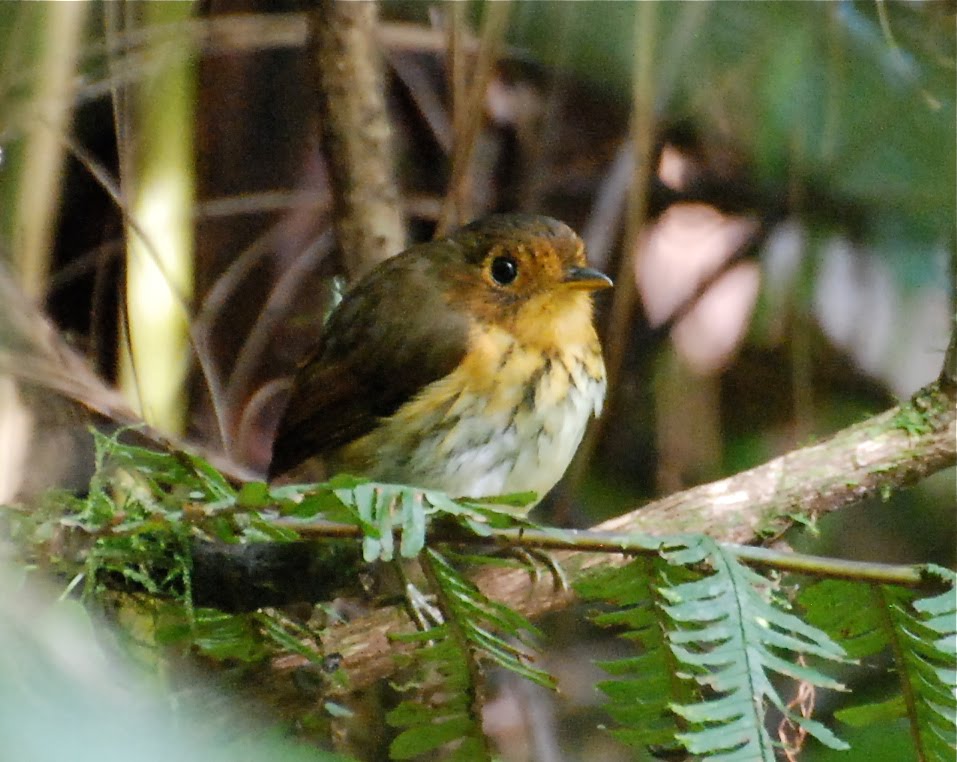
Although the early morning was a little too sunny for my tastes, even blindingly bright at times, the birding for most of the day was outstanding. Highlights included seeing an Ocellated Tapaculo out in the open for a few seconds as it fell out of the undergrowth as I passed by; I tracked the bird for a minute as it recovered from the surprise in deep cover off the trail. A massive raptor also caught my attention as it soared over the primary forest several kilometers away; it passed just overhead several hours later, but as I couldn't see more than a silhouette, it's difficult to say whether it was actually a raptor, such as the Black-and-Chestnut Eagle, or just a Turkey Vulture. Another mystery was this bird I photographed as it accompanied a mixed understory flock. In my humble estimation, it looked, and acted, like a bush-tanager, but it has little in common with the Dusky Bush-Tanager and it's way too high in elevation to be the ultra-rare Yellow-Green Bush-Tanager. Isn't it amazing how you can be pretty familiar with the avifauna at a particular site (I've birded this area many times over the years), and then be stumped multiple times in just a few hours, even with a decent photograph of the bird?

Update: Mindo Bird Tours guide Dusan who runs the wesbite Aves Ecuador has informed me that this mystery bird is actually a juvenile Dusky Bush-Tanager; the bird's head and belly should turn gray shortly, and its iris is likely more reddish when seen in a different light, he says. Now, there's a guy who really knows the birds of the region.

Notable birds seen: Sickle-Winged Guan, White-Throated Quail-Dove, Scaly-Naped Amazon, Tawny-Bellied Hermit, Gorgeted Sunangel, Masked Trogon, Plate-Billed Mountain-Toucan, Streaked Tuftedcheek, Strong-Billed Woodcreeper, Chestnut-Crowned Antpitta, Spillmann's Tapaculo, Ocellated Tapaculo, Smoky Bush-Tyrant, Red-Crested Cotinga, Green-and-Black Fruiteater, Sepia-Brown Wren, Capped Conebill, Rufous-Chested Tanager, Blue-and-Black Tanager, Hooded Mountain-Tanager, Dusky Bush-Tanager, Scarlet-Bellied Mountain-Tanager, Grass-Green Tanager.